
Commercial Snow Removal & Parking Lot Plowing in Grand Rapids, MI – Rely Snow Removal
Request a Free Estimate
We're ready to take on your property!
Rely Snow Removal Grand Rapids provides commercial snow removal for property managers and business owners in Grand Rapids, MI, backed by 15 years of experience through West Michigan winters. When your property has to be open before staff and customers arrive, our parking lot snow plowing covers drive aisles and occupied parking areas. A commercial snow plowing plan can also include loading docks and ramps, fire lanes, accessible stalls, and building entrances. Commercial accounts cover properties including office lots, retail centers, medical buildings, warehouses, and multi-site portfolios. Each property receives a written scope, placing the work within our wider snow-and-ice lineup for West Michigan properties through the winter.
Each account has a site map of snow-storage areas and traffic flow. Loaders with box pushers hold the pavement clear, while skid-steer loaders work in tighter sections. Dispatch begins at a set snowfall trigger, and weather alerts provide about 3 hours of notice. Our 24/7 storm response keeps the dispatch line active as conditions change. Every visit is logged. Rely Snow Removal is licensed and insured, and commercial account holders can request a certificate of insurance.
Lake-effect snow off Lake Michigan can leave different accumulation totals from one route to another across Grand Rapids, Wyoming, Kentwood, and Walker. We serve commercial properties throughout Kent and Ottawa Counties with contracts built around access before the workday and documented service records for your property team.
Parking Lot Snow Plowing
When customers, employees, and deliveries need access during a storm, your parking lot snow removal route has to account for parked cars, islands, and light bases. Commercial parking lot snow plowing requires a planned route rather than the approach used for a large driveway. We use plow stakes to mark hazards and a skid-steer loader to work around tight obstacles.
Clearing a Lot in Passes, Not One Long Push
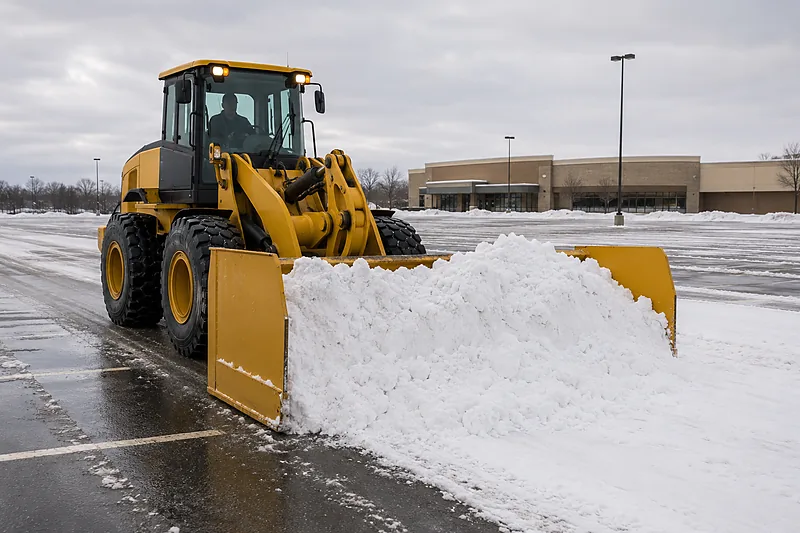
We first open a travel lane with a V-plow, then widen the working area in controlled passes. Windrowing rolls the snow along one line toward the planned stack instead of carrying it back and forth across your lot. A box pusher, also called a pusher box, moves each run to the stack, which grows from one end so there is room for later pushes. At walls and dock aprons, back-dragging pulls snow away from the edge before it is pushed forward. Once vehicles leave, a clean-up pass collects the snow that was left around them.
Parked Cars, Islands, and the Obstacles a Lot Adds
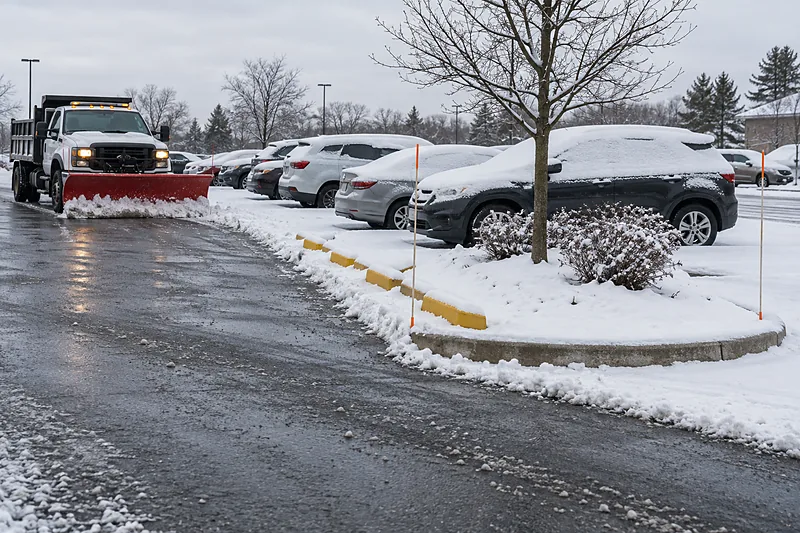
A car left in a stall overnight changes how that row can be cleared. We plow around the vehicle and mark the row so the occupied space remains part of the parking lot snow clearing plan. Six inches of snow can hide curb stops and wheel stops, so the operator lifts the blade at their marked locations. Around concrete islands, bollards, and cart corrals, we also lift the blade and finish the tight areas by hand.
What Commercial Snow Removal Covers at Your Property
Your commercial snow removal contract treats the property as a group of working surfaces, each with its own scope. During the site walk, we identify every covered parking area, fire lane, accessible stall, and service entrance so you know what the contract includes.
Lots, Drive Aisles, and Fire Lanes
We use a box pusher to open the parking lot, the approach from the street, and each drive aisle. The drive aisles stay at full width so two-way traffic and delivery trucks have room to pass. We clear traffic surfaces down to the pavement instead of leaving a packed layer that can glaze over. During the same visit, we remove the road-plow ridge from the entrance apron, while fire lanes are cleared and kept clear.
Loading Docks, Ramps, and Service Entrances
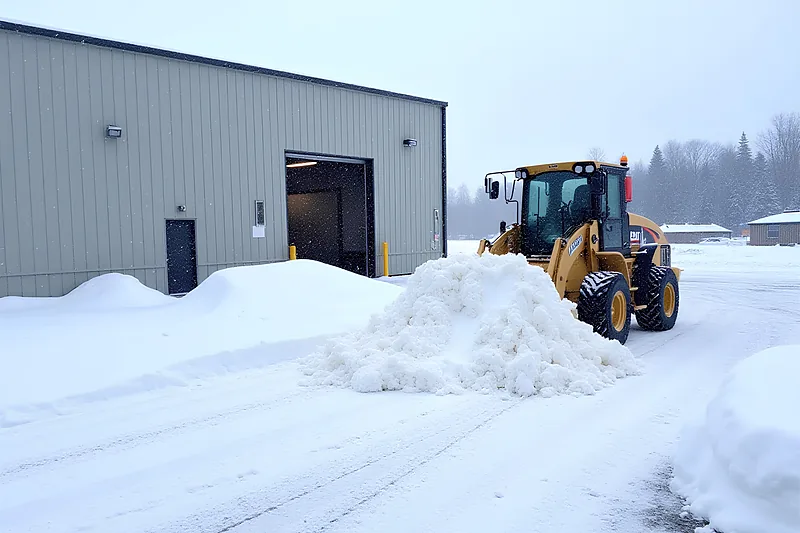
Because a dock well sits below grade, it collects snow and meltwater where drainage is limited. We use a skid-steer loader around the loading dock, loading ramp, and service entrance, scheduling the work around your delivery windows. If a trailer blocks a position, the contract calls for a return pass after it moves rather than leaving that position out of the scope.
Walkways, Entrances, and Ice Control
Separate crews work on your walkways while plows clear the lot, allowing both parts of the commercial snow and ice management work to finish within the same service window. A walk-behind blower and power broom clear the building frontage, entrances, and commonly used steps. Sidewalk snow removal has its own page, while de-icing and salting is covered by its own service page.
Commercial Properties We Plow Across West Michigan
When you manage a commercial property, operating hours, traffic patterns, and exposure during a storm all shape the service you need. We schedule business snow removal around your building’s clock because a retail center, medical office, warehouse, and multi-building campus each place different demands on the same crew.
Retail Centers, Restaurants, and Storefront Lots
Customers need a clear route from their cars to your entrance before the doors unlock. For a retail center, restaurant, or storefront, the service plan puts the first commercial snow plowing pass ahead of opening time. As cars come and go, stalls become available a few at a time, so we make clean-up passes throughout the day instead of treating the retail lot as a single sweep. The route also includes cart corrals, curb ramps, and the crossing to the entrance. At restaurants, the schedule accounts for the evening peak.
Offices, Medical Sites, Warehouses, and Campuses
Office lots fill around morning arrivals, lunch trips, and evening departures, so we time service around those waves. At a medical office or medical campus, your plan prioritizes the patient drop-off because some patients cannot cross an ice-glazed stall. Warehouse work keeps enough turning room open across the truck apron and dock approaches. For a multi-building campus, we clear each building and the connecting drives during one visit.
Service Levels for Commercial Snow Removal: Trigger or Bare Pavement
How much snow your property can tolerate during operating hours determines the right service level. A trigger-based plan begins at an agreed snowfall depth, while zero-tolerance service keeps crews assigned throughout the storm to maintain bare pavement. Contracts can use per-visit or seasonal terms, with pricing quoted separately.
Trigger-Based Clearing at a Set Depth
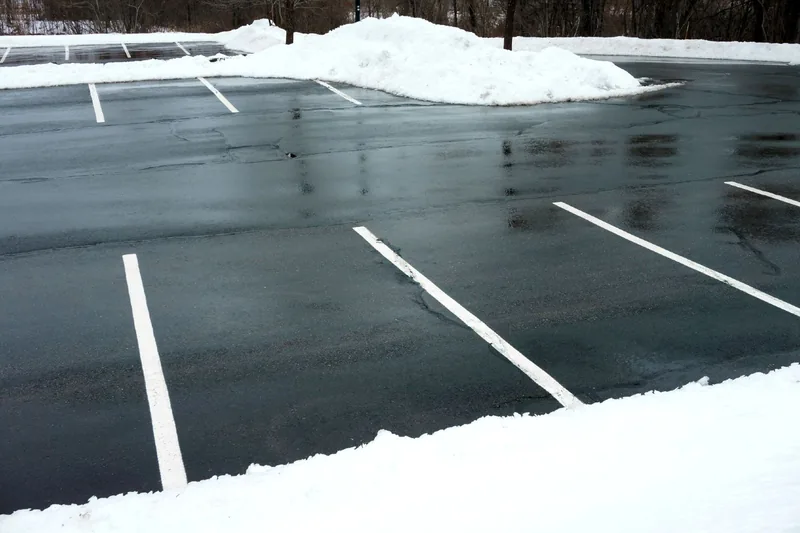
For properties that can remain open through light accumulation, a written trigger gives everyone a clear point for starting service. When snowfall reaches the 1 to 1.5-inch dispatch trigger, we begin the scheduled clearing route. The midnight-to-7 am overnight route prepares the lot for morning operations. Because the decision point is part of the agreement, your property manager does not have to monitor the snowfall and decide when to send a crew.
Zero-Tolerance Sites That Stay Bare
Hospitals, round-the-clock retailers, and properties with heavy foot traffic may need pavement kept bare while snow is still falling. Under this zero-tolerance service level, our crews remain assigned to your site instead of making a single overnight pass. The agreement also identifies each priority zone in writing, so service follows the operating needs established for your property throughout the storm.
Priority Order: What Opens First During a Storm
During a storm, the areas people need first cannot all be cleared at the same moment. A written order for each priority zone keeps the storm response focused on usable access while snow is still falling. Our commercial snow removal crews stage equipment, follow that order, work around areas reserved for snow piles, and return for another pass as conditions change.
Opening Access Before the Lot Is Finished
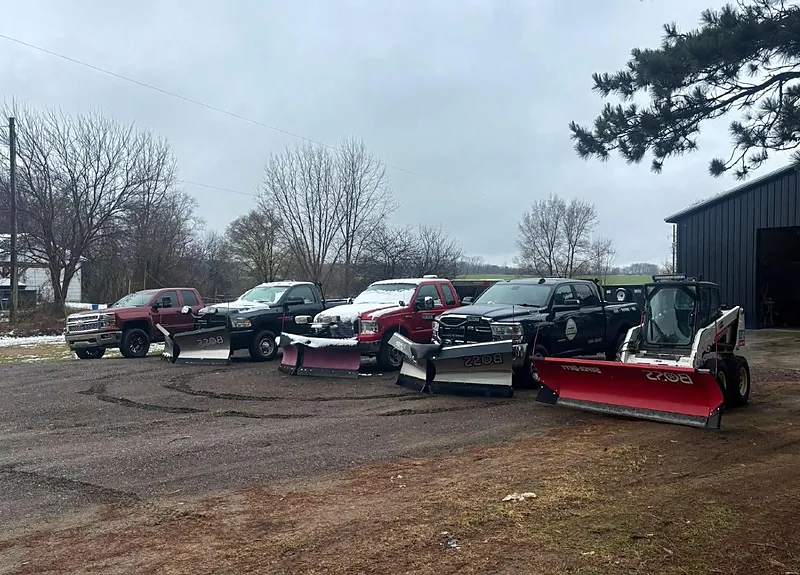
With about 3 hours of weather-alert notice, we stage equipment before snowfall and begin with the highest-priority areas, including your main entrance, fire lanes, accessible stalls, and primary drive aisles. Other zones follow in order, including secondary parking, perimeter rows, and overflow spaces. Opening those first areas early gives people a way into the property while the crew continues clearing the rest of the lot.
Return Passes While Snow Is Still Falling
A return pass keeps those priority areas usable in the meantime. Once accumulation climbs past about 4 inches, we add daytime passes, so prolonged snowfall can bring more than one visit within 24 hours. After parked cars leave, the closing pass removes the entrance ridge and clears stalls that were occupied overnight. Dispatch follows the trigger and route conditions, not a promised arrival time. Dispatch runs 24/7 storm response through the winter season, and crews roll within hours of a storm. When you call, you get a time window for your property.
Equipment Matched to the Lot
Before assigning commercial snow removal equipment, we consider your lot’s square footage, obstacles, and available pile space. We then choose equipment that fits the property, including a front-end loader, skid-steer loader, V-plow, hopper spreader, or toolcat, a compact machine sized for sidewalks and other confined spaces.
Loaders, Box Pushers, and Skid-Steers
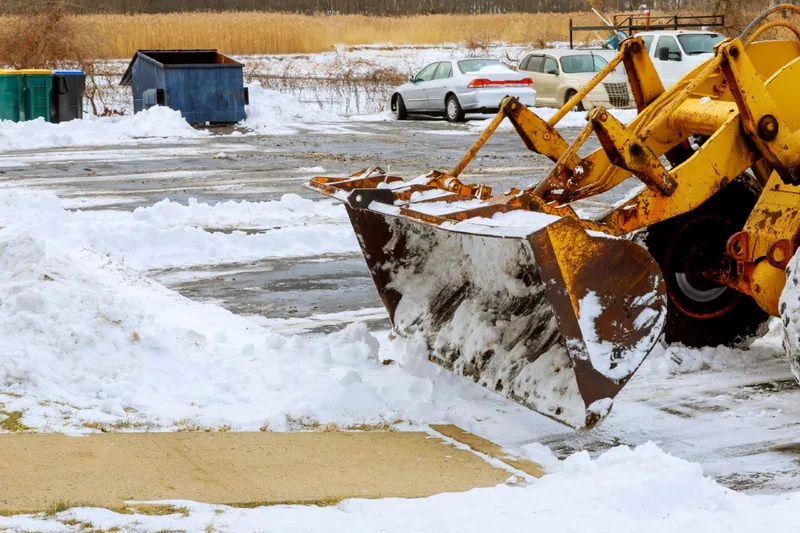
Open lots, tight aisles, and confined walkways each need equipment suited to the available space. For commercial plowing on open properties, we pair a front-end loader with a box pusher. A box pusher is a wide square blade with end plates that hold the snow during long pushes instead of letting it spill sideways. A skid-steer loader handles tight aisles, dock aprons, and dumpster enclosures during commercial snow plowing, while a truck-mounted V-plow opens a lane through the lot. We assign a toolcat to accessible routes and confined walks. On larger lots, a dump truck carries the hopper spreader.
Cutting Edges and the Surfaces They Have to Protect
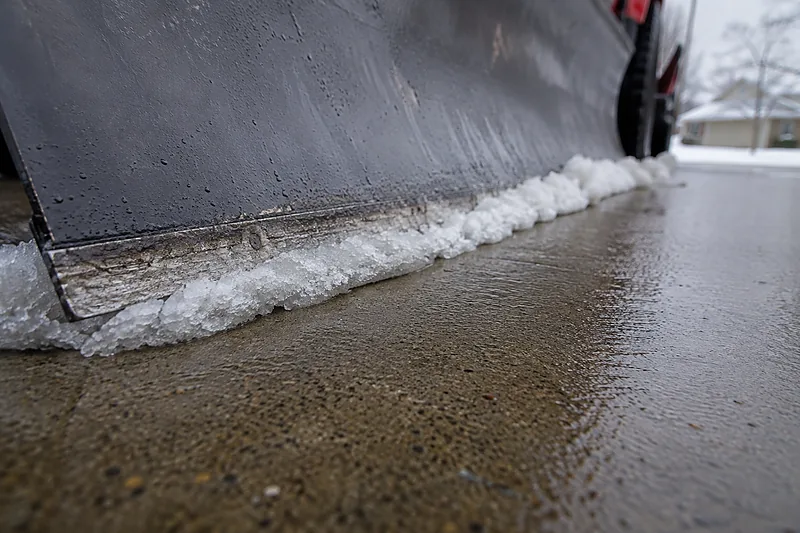
A cutting edge is the replaceable wear strip bolted along the bottom of a plow blade, and the wrong one can gouge aisles, damage curb ramps, and leave spring repair bills. Before commercial snow removal begins for the season, we explain which cutting edge fits each surface and how it balances scraping performance with pavement protection. A polyurethane cutting edge does not scrape as thin as steel in freezing conditions, but it flexes over surface irregularities and holds up well under down pressure, protecting concrete, asphalt, and pavers. Steel scrapes hardpack best, but it offers less protection for the pavement. On decorative finishes and pavers, we reserve rubber cutting edges for areas where avoiding marks matters more than scraping hard.
Snow Storage: Where the Piles Go, and When They Move
Because plowed snow stays on your property unless it is hauled away, commercial snow removal needs assigned pile ground from the start. During the site walk, we select each snow-storage area and fix its location before the season begins.
Mapping Storage Areas Before the First Storm
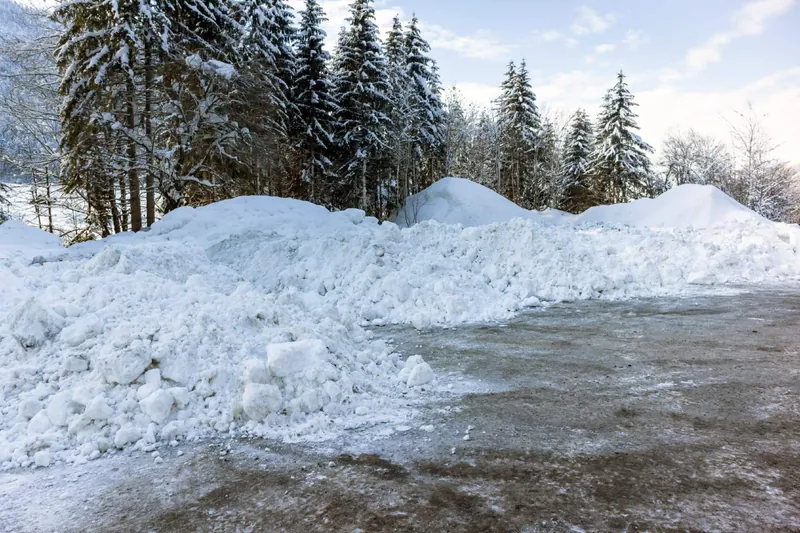
The site map records pile locations, traffic flow, and the parts of the property that must remain open. We place storage away from exit sight lines and drive approaches, while keeping each catch basin open so meltwater can drain. Choosing pile ground in advance protects the parking count through the season. Plow stakes mark each curb, island, and light base so the operator can see those hazards after snowfall covers them.
When Piles Have to Leave the Property
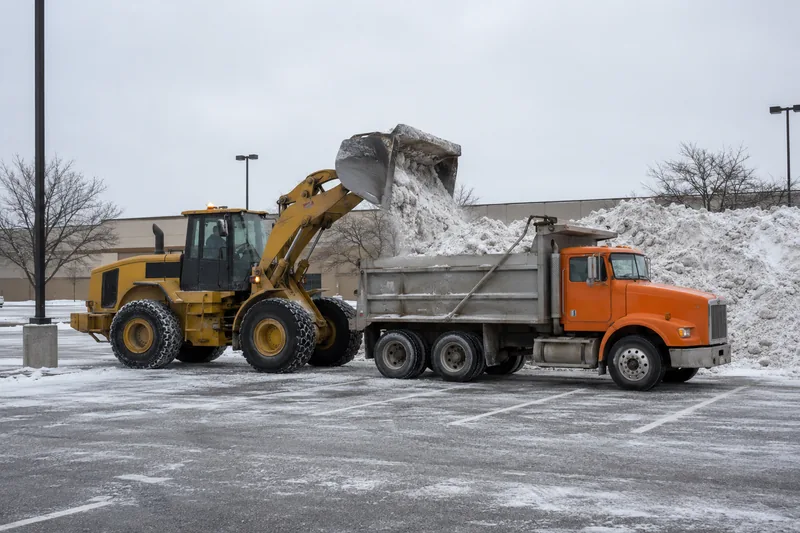
A hard winter can fill every designated storage area, leaving piles to take parking stalls, narrow sight lines, or send meltwater back across your lot. When another mapped storage area still has capacity, we relocate the snow on-site without sending it off the property. If no suitable space remains, load-out is covered by our separate snow hauling and relocation service.
Why Choose Rely Snow Removal for Your Commercial Property
Keeping a commercial property open through a storm takes a plan that your manager, board, or insurer can review. Rely Snow Removal starts with a site map, and every visit is logged. The account record is available to your manager, board, or insurer.
- You do not have to call for service because dispatch begins at the trigger.
- To prepare the property before workday traffic, we place it on an overnight route.
- Because the equipment needs to fit the lot, our commercial fleet includes loaders with box pushers, skid-steer loaders, and toolcats assigned according to the property.
- We match the cutting edge to the surface named in your site map.
- Our route team monitors the storm forecast window and receives about 3 hours of weather-alert notice.
- Rely Snow Removal is licensed and insured, with a certificate of insurance available on request for commercial accounts.
- Our crews bring 15 years of experience working through West Michigan winters.
- Multi-site accounts have one point of contact across every property in your portfolio.
- When on-site storage runs short, commercial plans can include snow relocation and load-out.
When comparing commercial snow removal companies, ask to see the equipment yard, insurance documents, route-management practices, and service record. Call (616) 883-2471 or request a free estimate for your commercial property.
What Commercial Snow Removal Costs in Grand Rapids
What the work costs depends on how crews must move through and clear your property. Because a standard lot price cannot account for those differences, we provide a quote after a site walk. The main commercial snow removal pricing factors include the cleared area, traffic demands, and route design, which determine the labor and equipment required.
- We measure the square footage that crews will clear rather than the full parcel size.
- Islands, curb ramps, dock wells, and tight aisles add maneuvering time and limit the size of equipment that can fit.
- Your traffic flow and operating hours determine how crews work around customers, employees, deliveries, and occupied parking spaces.
- The property’s position on the route, the required push distance, and the distance to snow storage all affect the commercial snow removal cost.
- Clearing at the trigger costs less than maintaining a service level that holds the pavement clear.
- De-icing charges depend on the amount and type of material applied to your property.
- When on-site storage fills, load-out is billed by the loader hour.
You can choose per-visit billing, which charges for each event, or a flat-rate seasonal contract covering unlimited events. With per-visit terms, daytime passes past about 4 inches count as additional events.
To receive a free estimate after a site walk, send us your property details or call (616) 883-2471.
How Commercial Snow Service Works, From Site Walk to Spring
A commercial snow removal plan should be ready before the first storm. Rely Snow Removal sets up the agreed routine with you before the season.
-
Request a Free Estimate
To start your free estimate, send your lot dimensions, operating hours, and access restrictions. We also ask whom our crews should contact during a storm.
-
Walk the Site and Map the Snow
During one site walk, you approve the site map, confirm the snow storage areas, and identify what must remain clear. Our crew also installs the plow stakes shown in the plan.
-
Set Your Service Level and Priority Zones
Different parts of the property may need to open at different times. Your service-level agreement records the dispatch trigger, selected service level, and each priority zone. You approve those priorities in writing.
-
Storm Response Without a Phone Call
When snowfall reaches the dispatch trigger, your overnight route begins without a phone call. We position equipment ahead of the storm, crews return during prolonged snowfall, and every visit is logged.
-
Season Review and the Spring Return
Because plows can scuff turf or nick a curb over the winter, the spring return trip is when we put that damage right, provide the season log, and update the site map for next winter.
Call (616) 883-2471 to arrange your site walk and free estimate before the snow season.
Fire Lanes, Accessible Stalls, and Where Snow May Not Be Piled
Even with a storage plan in place, some parts of your lot cannot be used for snow piles. We mark accessible parking, fire lanes, hydrants, and required routes on the site map as no-pile areas. The restrictions apply regardless of what your commercial snow removal contract allows.
Accessible Parking and the Route to the Door
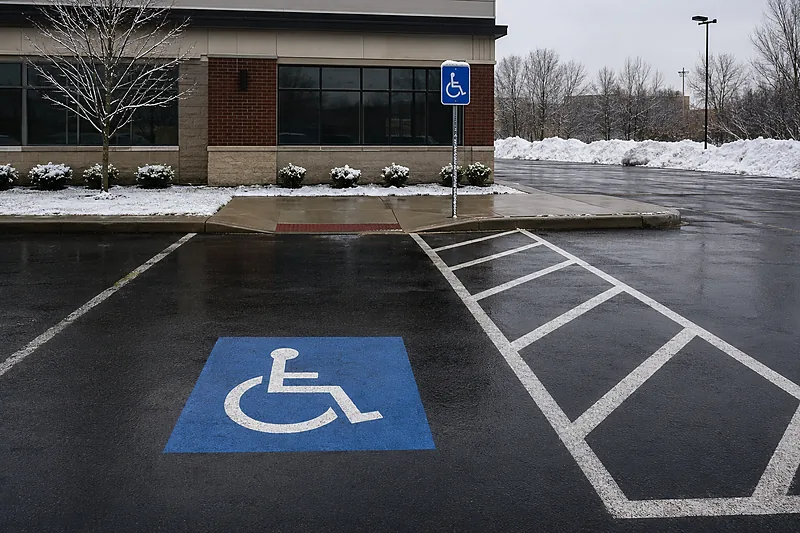
A fully plowed lot can still be unusable if a snow pile lands in the wrong place. Under federal ADA maintenance requirements (), your property’s accessible features must remain usable. We therefore exclude the striped access aisle beside each accessible stall and the curb ramp from every pile location. The accessible route from parking to the entrance receives the same protection.
Fire Lanes and Hydrants
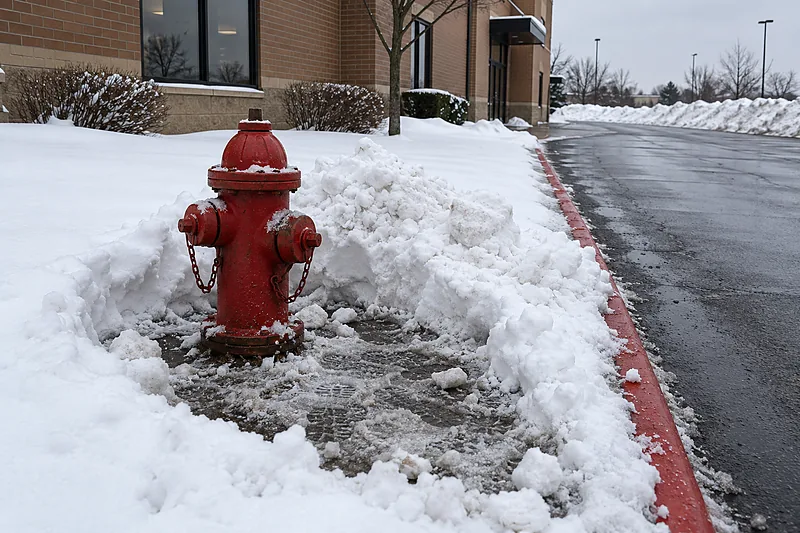
Snow piled in a fire lane or around a hydrant can block emergency access to your property. Under the fire code your city adopts (), your fire lane must remain unobstructed at all times, with fire hydrants and their approaches kept reachable. The required lane width comes from the locally adopted code edition and amendments, rather than one figure that applies to every commercial property.
The Service Record Behind a Commercial Account
The service record is a formal deliverable for property management, rather than an informal courtesy prepared only when someone requests documentation.
What Your Visit Log Shows
When someone asks how your property was handled during a storm, the service record provides a time-stamped account. Each plow visit and material application has a date and time, creating a visit and material application record for your account. The log shows an insurer, owner, board, or tenant what the crew did and when.
In Michigan, the 2023 Supreme Court ruling in Kandil-Elsayed v. F & E Oil changed how snow-and-ice claims are judged: an open and obvious hazard alone no longer bars a claim. Reasonable maintenance carries weight, so what was done and when is the kind of evidence that question turns on. It supports a liability review, but it does not determine that the surface was free of hazards.
Certificates of Insurance and Property Files
Rely Snow Removal is licensed and insured and provides a certificate of insurance (COI) on request for each commercial account. The certificate is the document that evidences the contractor’s coverage for the property file. Before the season, the property manager keeps the certificate with the commercial snow contract as part of the account documentation.
Multi-Site Portfolios, HOAs, and Coordinated Snow Service
When your property management responsibilities cover several properties, commercial snow removal becomes a coordination job before the first plow moves. The schedule must bring several properties together instead of covering a single site.
One Point of Contact Across Several Sites
During a storm, one point of contact saves you from chasing several contractors for updates. We write the same service level and priority zones into each site map across your portfolio, then arrange the multi-site route around each property’s opening hour. Every location receives its own report, ready to send to the appropriate owner without compiling records from several crews.
Private Roads, Shared Drives, and Common Areas
Shared roads and common areas need to open together for an HOA community to function normally after snow. For HOA snow removal, we coordinate private roads, shared drives, and mailbox clusters in one community route. Clubhouse and amenity lots are cleared in the same pass as visitor parking and each common area, rather than leaving the community to open piecemeal. The board receives a record of every visit. Individual unit driveways fall under residential snow removal, which has its own page.
Commercial Snow Removal Across Kent and Ottawa Counties
Grand Rapids averages 77.6 inches of snow each year under the 1991–2020 climate normal, with much of that snowfall coming from lake-effect storms off Lake Michigan. Grand Rapids sits about 25 miles east of Lake Michigan and anchors the commercial corridors of the metro area and the wider West Michigan economy. Industrial parks, retail centers, offices, and distribution properties shape that regional business landscape. Commercial properties along the county’s corridors and in its business parks need to preserve customer parking, delivery access, and working space throughout the season.

Where Rely Plows Commercial Property
Rely Snow Removal serves commercial properties across Kent and Ottawa Counties, with a service area that includes:
- Grand Rapids, MI
- Wyoming, MI
- Kentwood, MI
- Walker, MI
- Grandville, MI
- Jenison, MI
- Forest Hills, MI
- Ada, MI
- Cascade, MI
- Lowell, MI
- Byron Center, MI
- Caledonia, MI
- Rockford, MI
- Comstock Park, MI
- Plainfield Township, MI
- Belmont, MI
- Northview, MI
- Standale, MI
- Cedar Springs, MI
- Sparta, MI
- Cannonsburg, MI
- Alpine Township, MI
- Kent City, MI
Commercial Snow Removal Questions, Answered
These are concise answers to common commercial snow removal questions.
How Much Does Commercial Snow Removal Cost in Grand Rapids?
When Do Your Crews Plow a Commercial Lot After It Snows?
Where Does the Snow Go When My Lot Runs Out of Room?
Do You Clear Loading Docks and Fire Lanes?
Can I Get a Certificate of Insurance for My Commercial Account?
Can One Contract Cover Several Properties?
For terms specific to each property, request a commercial snow estimate.
Start a Commercial Account With Rely
Before the seasonal schedule fills, make sure your Grand Rapids property has a commercial snow removal plan built around the site. Ask Rely Snow Removal to walk the property and prepare a free estimate. Call (616) 883-2471 or use the quote form to request your site walk. We will review the property with you and build the account around its needs.